An orchestra seating chart places the strings in a fan across the front of the stage, woodwinds in the center rows behind them, and brass and percussion at the back. The conductor’s podium is at the front center, and every section is angled toward the podium.
Beyond that ten-second answer, the work is in the assignments: placing players stand by stand, fitting the fan to your stage, and keeping the chart true as the roster changes between the first rehearsal and the concert. This guide covers all three.
The standard layout, section by section
One common arrangement puts first violins on the conductor's left, then second violins, violas, and cellos sweeping to the right, with basses behind the cellos. Woodwinds sit in two rows at the center, brass behind them, and percussion across the back.
Use this diagram as a starting example. Ask the music director which section order they want, then check sightlines, space, and equipment with the venue crew. A familiar arrangement can simplify communication, but the chart should describe this performance’s needs.
Variations you will run into
Concert programs and guest conductors sometimes call for an antiphonal arrangement, which splits the violins — firsts on the conductor's left, seconds on the right — so the two violin lines answer each other across the stage, the stereo effect composers from Haydn through Mahler wrote for.
Three examples of string orders are firsts, seconds, violas, cellos (the standard above); firsts, seconds, cellos, violas (violas outside right); and the antiphonal firsts, cellos, violas, seconds shown here. Wind, brass, percussion, and lower-string positions can also change with the repertoire, stage, and conductor’s preferences.
Discuss an antiphonal setup with the conductor and section leaders before changing the chart. Rehearsal time, the repertoire, and the hall all affect the decision. Mark orientation and stand assignments clearly so players can prepare for the arrangement you choose.
How to build the chart, step by step
- 1
Count your real players, not your ideal ones
Start from the roster you have for this concert: who is confirmed, who has conflicts, who is new. A chart built from September’s roster is fiction by May. - 2
Fit the standard layout to your stage
Lay out the fan (string arcs in front, two wind rows, brass, percussion) and bend it to reality: shorten arcs, straighten a back row, pull the whole fan forward. Confirm space needs with the players and venue crew. Allow for bows, endpins, stands, instrument changes, accessible routes, and sightlines. Measure the stage and test the layout before publishing it. - 3
Get the string order from your concertmaster
Who sits which stand is a musical and political decision, and it isn’t the manager’s to make. Principal chairs and stand order come from the music director and concertmaster; rotation policy comes from tradition or the board. Your job is to capture their answer accurately and publish it rather than referee it. New managers get burned skipping this step exactly once. - 4
Name every chair, including the empty ones
Assign the bulk of the ensemble section by section, then handle the exceptions. A truthful chart with two “TBD” chairs is more useful than a pretty one that hides the problem. - 5
Publish it where players can see it, and date it
A chart on the director’s laptop helps nobody at 6:55 pm on rehearsal night. Post it where every member can check their own seat, and date it so nobody trusts an old version.
The hard cases: percussion, harp, and piano
Percussion is the seating problem most charts treat as an afterthought strip across the back. Plan it around three constraints: floor space for the specified instruments, the cartage path (mallet instruments come in through the loading door and shouldn’t cross the string section to reach their spots), and sightlines over the battery to the podium. Confirm positions and clearances with the percussionists; they need room to move between instruments.
Harp and piano usually live on the left, near the first violins. The harpist needs the conductor in natural eyeline past the instrument, and a piano’s open lid should face the audience. Neither rolls easily, so place them before you finalize the string arcs around them rather than after.
The messy realities
Community orchestras rarely match the textbook diagram. The common adjustments:
- Uneven strings. Ten firsts and four violas is normal. Keep the fan shape but narrow the viola wedge rather than leaving holes — a compact section sounds better than a scattered one.
- Small stages. Review a smaller layout with the venue crew and section leaders. Preserve safe clearances, access routes, and sightlines; do not squeeze players into an unsuitable stage.
- Late changes. Someone gets sick the week of the concert, and a hired sub says yes on Thursday. Put the replacement in the exact chair of the player they replace and tell the stand partner — a new face reads better next to a confident regular than parked at the back of the section.
- Rotating seating. Many community orchestras rotate string players behind the principal stand each concert. It defuses seating politics, but it means a new chart every cycle. Software spares you the redrawing and the republishing; the reassignments are still yours.
Drawing takes an evening. Maintaining takes the season.
Every change — a new member, a swap, an illness, a section rebalance — invalidates the drawing, and a PowerPoint file or a photo of the rehearsal-room board has no idea who is in your orchestra or when your concert is.
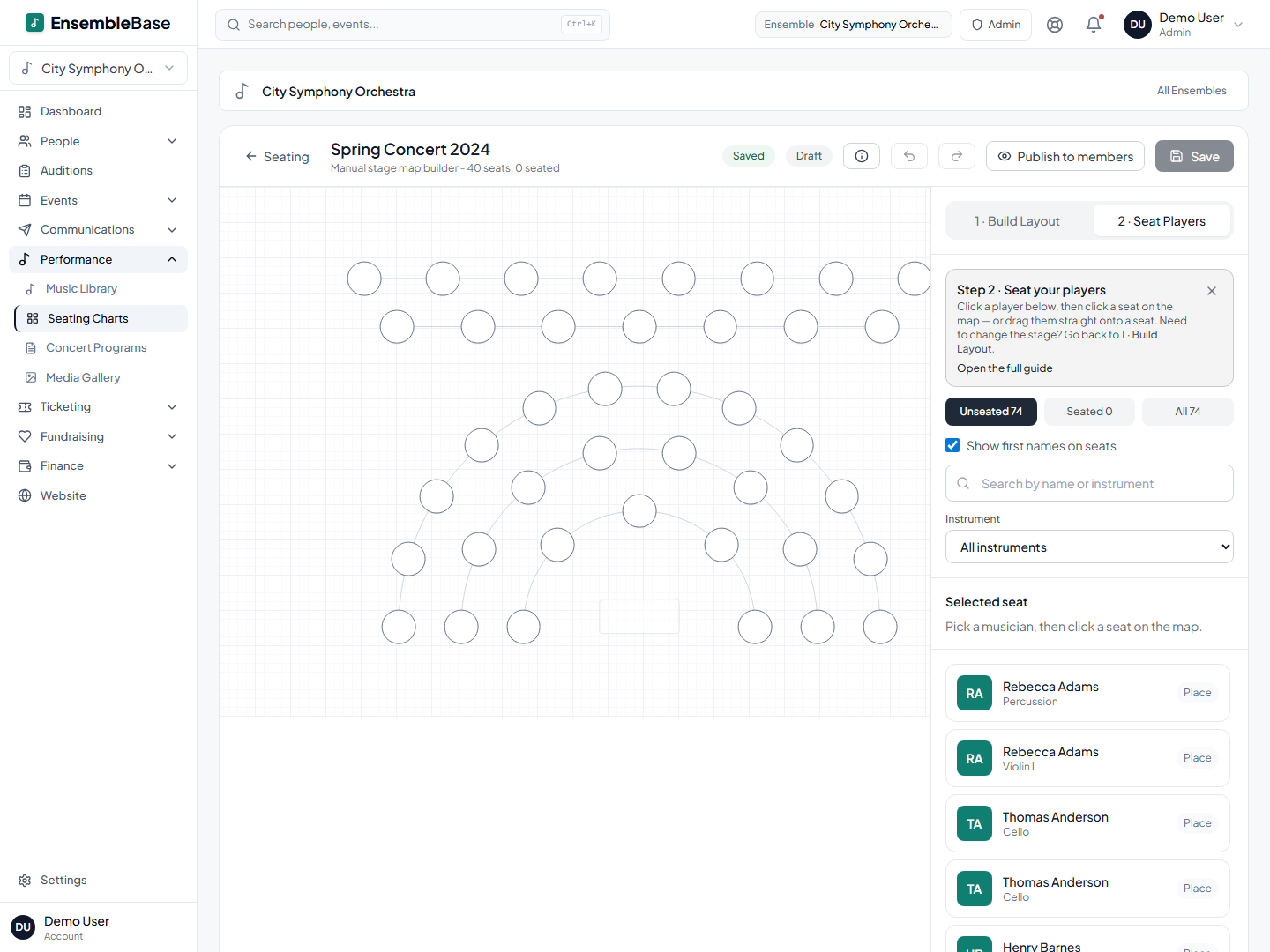
This is why we built seating into Arts in One around the roster instead of around the drawing. You start from an adjustable template and shape the rows into the fan; the builder shows your member list beside the stage (filter to who's unseated, drag each player to a chair) and prompts a swap when you drop someone on an occupied seat. Link the chart to the concert and the availability answers show up on the chart itself, chair by chair, before rehearsal night. When you publish, every player sees their own seat in their member portal.
One roster powers everything
In Arts in One, your member list is entered once and reused everywhere. Every tool below works from the same roster — no re-typing names, no out-of-sync copies.
Frequently asked questions
Why do first violins sit on the conductor’s left?
It is a common convention, but placement varies. The music director chooses a layout for the repertoire, ensemble, and hall; this guide illustrates options rather than prescribing one arrangement.
Where do the violas go?
In the standard layout, violas sit center-right between the second violins and cellos. In the European variation they move inside, next to the cellos. Either way, keep them as a compact block; violas suffer most from being spread thin.
How much space does each musician need?
Space needs depend on the instruments, equipment, stage, and access requirements. Confirm clearances with the players and venue crew, then test the layout with chairs and stands in place. A single area-per-player number is not a substitute for that check.
Who decides the seating chart — the conductor or the manager?
Musical placement (who sits principal, any layout changes) is the music director’s call. Turning that intent into a maintained, published chart every week is an administrative job, which is why it usually lands on the ensemble manager, and why tooling matters.
Keep reading
Seating & staging
Seating chart software that starts with your roster, not a blank canvas
Read the guideOperations
Planning a concert season: the master timeline and checklist
Read the guideOrchestra operations
Community orchestra management software that replaces the spreadsheet stack
Read the guideTicketing & box office
How to sell tickets for a community concert
Read the guideThe bottom line
Decided who sits where? Publishing it is the easy part.
Arts in One turns the decisions you collected into a published chart every player can check from their own portal.
Request a demo