Plan a concert season backward from the concert dates. Lock venues and repertoire 4–6 months out, open each concert's logistics 8 weeks out, and run the same per-concert checklist every cycle: written down, dated, and visible to the whole team.
A community ensemble season is two plans stacked together: one season-level plan (dates, venues, repertoire, budget, marketing) made once, and one per-concert countdown that repeats three to five times between September and May. Most season disasters come from treating each concert as a fresh improvisation. The double-booked venue, the rental parts that arrive two weeks late, the program that prints with last year's donor list: each one is a step a written checklist would have caught. Here is the full timeline.
6+ months out: dates, venues, repertoire, budget
Set concert dates before anything else. Venue availability drives everything downstream (rehearsal schedules, repertoire deadlines, marketing windows), so the first act of season planning is putting dates on the calendar and confirming the hall can honor them. Check them against school calendars, major holidays, and the other arts organizations in town before you commit.
Book venues and get contracts in writing. A friendly verbal hold from the church office administrator is not a booking. Get a signed agreement that covers the date, load-in and rehearsal access, the fee, insurance requirements, and cancellation terms. Do the same for your dress-rehearsal venue if it differs from the hall.
Book the weekly rehearsal space too. Thirty Tuesday nights is a harder negotiation than one Saturday: custodian schedules, the church's Lenten calendar, the school gym's basketball season. Confirm the whole run now, in writing, including the weeks you assume are fine.
Put grant deadlines on the same calendar. Schedules differ by funder and program. Check the current published deadlines and add them to the calendar with an owner for each application.
Draft repertoire with lead times in mind. The music director's wish list meets two practical filters: licensing and rental availability, and your actual roster. Rental houses can take weeks to quote and ship, and popular works get reserved by bigger orchestras early, so check rental lead times before announcing anything. Log the season's works in your music library now so parts, rentals, and return deadlines are tracked from day one.
Set the season budget. Here is a worked, illustrative budget for a 60-member community orchestra running a four-concert season. Your numbers will differ; the shape usually doesn't. Venues run anywhere from a donation to your host church up to $3,000 for a proper hall — this sketch assumes a modest rented one.
| Expense | Amount |
|---|---|
| Concert venue (4 × $1,200, incl. dress rehearsal access) | $4,800 |
| Weekly rehearsal space (30 weeks × $75) | $2,250 |
| Music purchase and rental (4 programs) | $2,000 |
| Music director stipend | $6,000 |
| Liability insurance | $800 |
| Marketing and program printing | $1,200 |
| Miscellany and contingency | $750 |
| Total expenses | $17,800 |
| Income | Amount |
|---|---|
| Member dues (55 paying members × $120) | $6,600 |
| Ticket sales (4 concerts × 160 tickets × $15 avg) | $9,600 |
| Program ads and sponsorships | $1,800 |
| Donations | $1,500 |
| Total income | $19,500 |
Read the bottom line the way a board should: ticket sales cover just over half the cost of putting on the season. Dues and giving close the gap, so include a considered fundraising plan and avoid budgeting every concert as a sellout. Budget tickets conservatively and let a strong house be the upside. And if a grant is in play, put the deadline on the calendar and none of the money in the budget: grant income gets added when it is awarded, never before. If you hire ringers and section leaders, add a line at your written pay scale; it's often the largest expense after venues. Dues are usually the most predictable income line, which makes them worth systematizing; the full method is in collecting member dues without the awkwardness.
3–4 months out: announce, poll, recruit, market
Announce the season to members first. Your players should hear the dates and repertoire before the public does. It's a courtesy, and it's also how you find conflicts early. Send the full season calendar in one email and ask members to block the dates now.
Open availability polling per concert date. Do not wait for the week-of scramble: poll each member's availability for every concert and dress rehearsal while there is still time to act on the answers. Three violins out for the March concert is a solvable problem in December and a crisis in February.
Recruit and audition to fill gaps. The availability results tell you exactly where the holes are. Run auditions for permanent seats, and book known ringers for one-concert gaps, with rates agreed in writing and W-9s collected before the first service.
Launch season marketing. The season announcement is a marketing event in itself: new website copy, a season graphic, a press release to local outlets, and a save-the-dates email to last season's ticket buyers and donors. If you sell season subscriptions, this is when people buy them.
8 weeks out: the per-concert countdown begins
Everything above happens once. From here down, the sequence repeats for every concert on the calendar, and because it repeats, it should be a written checklist, not a memory exercise.
One more thing before the countdown: the checklist is a list of owners rather than tasks. Name who owns will-call, who owns the program, who owns the door float, and the president's job becomes asking three people "on track?" instead of doing thirty things personally.
Confirm personnel and subs. Re-check availability against the actual program, chase the maybes, and book subs for confirmed gaps. Every chair should have a name on it by the end of this week, even if some names are "sub — booked."
Confirm the rental parts have landed. The first rehearsal on a program falls around this mark, and parts should be in folders before it, bowings and markings included. A rental that has not shipped by eight weeks is a phone call today rather than a surprise at the first downbeat.
Open ticket sales. Eight weeks gives people time to put the date on the calendar, and gives you time to push harder if sales come in slow. Publish the public event page, set prices and any discounts, and start the three-wave promotion: announcement now, a reminder push at three weeks, and a final week-of wave. The full playbook (pricing, comps, door sales, check-in) is in the guide on how to sell tickets for a community concert.
4 weeks out: seating and program content
Draft the seating chart from the confirmed roster: sections, stands, principals, and the subs you booked at eight weeks. Drafting it now surfaces the last staffing problems while you can still fix them. The step-by-step method, including layouts and sub handling, is in the guide on how to create an orchestra seating chart.
Collect program content. Repertoire and movement listings, program notes, the personnel list, the donor acknowledgment list, and any paid ads. Set the internal deadline two weeks before print so one late bio doesn't hold up the whole program.
2 weeks out: print, people, reminders
Program to print: proofread names against the roster, donors against giving records
Door volunteers assigned by name: box office, will-call, ushers, scanner
Reminder email to members: call time, dress, parking, stand assignments
Reminder email to ticket buyers with date, time, and directions
Concert week: the last-mile list
By concert week, every decision should already be made. All that's left is doing things on time.
- Dress rehearsal logistics: hall access confirmed, chairs and stands counted, percussion cartage scheduled, and the run order posted.
- Will-call list printed and alphabetized, comps included, with one person who owns it at the door.
- Cash float for door sales: small bills and a coin roll, counted before and after.
- Scanner check: test ticket scanning on the actual device, on the venue's actual Wi-Fi, the day before — not at 6:45 pm.
- Stage plot to the venue so the hall crew sets the stage from your seating chart, not from memory of the last group that played there.
The week after: close the loop
Reserve time for follow-up before the next concert takes over. Within a few days: plan a thank-you and any appropriate follow-up while the performance is fresh. Respect recipients’ communication preferences when including future-event or donation messages. Send the board a one-page recap: attendance versus capacity, ticket revenue versus budget, and door-sale numbers. Then write the retrospective notes — what ran late, which deadline was fake, what the venue crew wished they had known — and pin them to the top of the next concert's checklist. That is how the second concert runs smoother than the first.
How this works in Arts in One
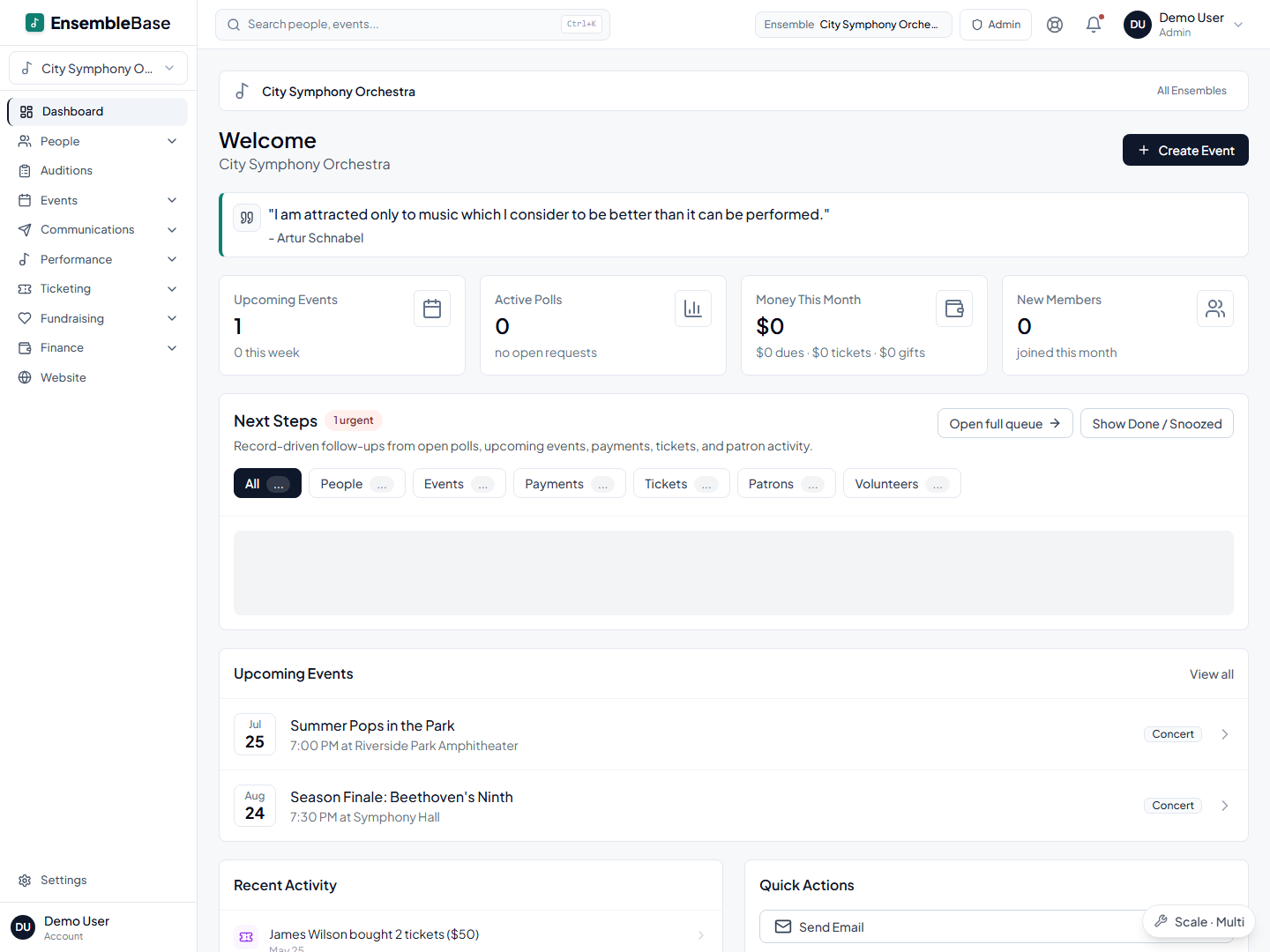
Every step above touches the same data: the events, the roster, the buyers, the donors. In Arts in One the season lives in one workspace, so the concert you schedule is the same event that drives its availability poll, its public ticket page, its seating chart, and its printed program, all from one entry of the date. The dashboard surfaces what needs attention this week: the poll with missing responses, the concert whose ticket sales just opened, the program still in draft.
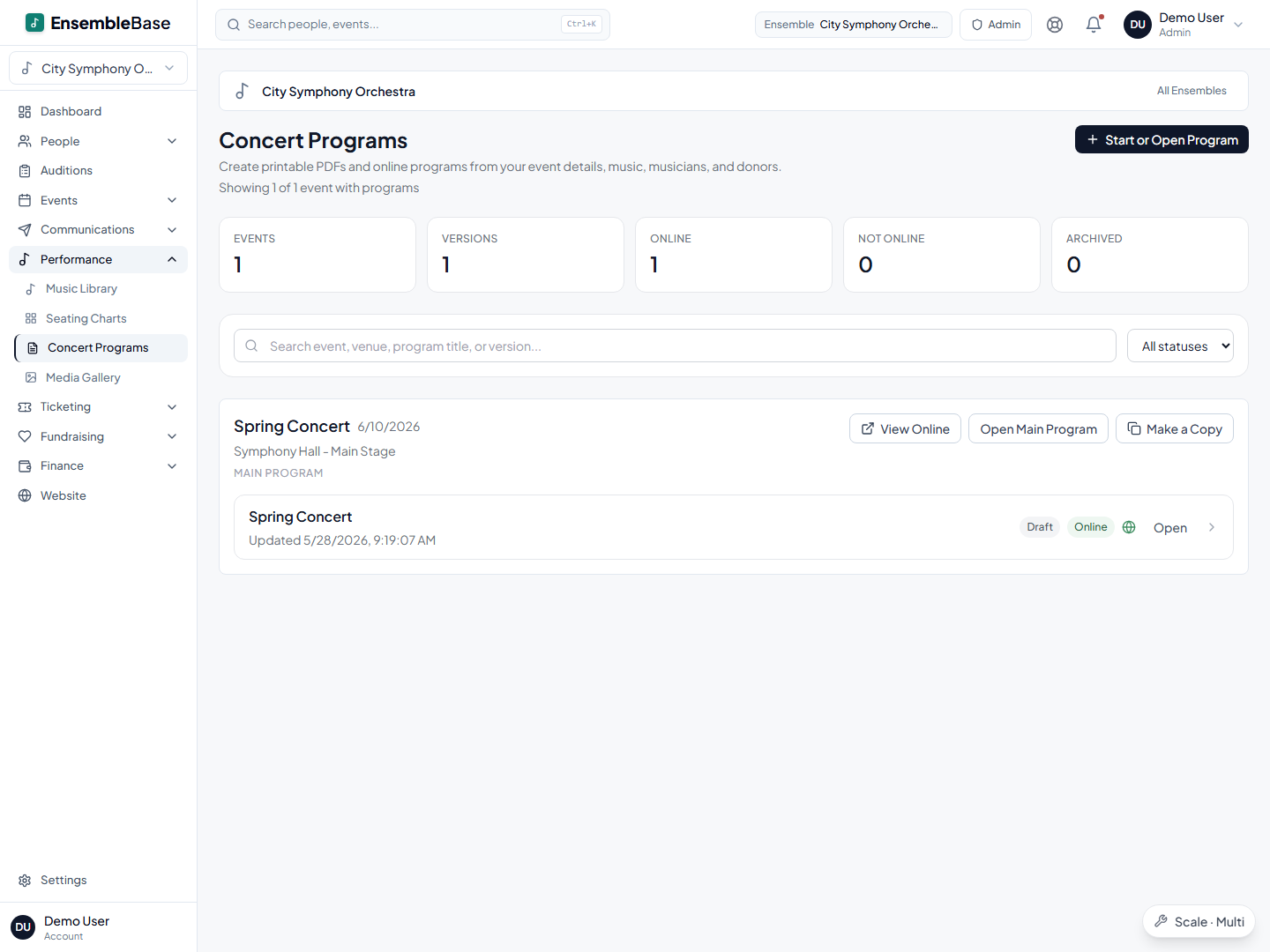
The program builder shows what this connection buys you: it reuses the event details, the roster for the personnel page, and donor records for the acknowledgments, and it keeps a live published version alongside a draft, so you can start the next revision without breaking the version your audience sees.
One roster powers everything
In Arts in One, your member list is entered once and reused everywhere. Every tool below works from the same roster — no re-typing names, no out-of-sync copies.
Frequently asked questions
How far in advance should a community ensemble plan its season?
Set concert dates and book venues 6 or more months out, because venue availability constrains everything else. Repertoire and budget follow at the same horizon since rental lead times run weeks to months. Member-facing steps (announcement, availability polling, recruiting) land 3–4 months out, and each concert then runs its own 8-week countdown.
What does a community orchestra season cost to run?
For a roughly 60-member community orchestra, venues run anywhere from a donation to your host church up to $3,000 for a proper hall, and music rental and purchase runs $300–800 per program. The worked budget in this guide lands at roughly $18,000 of expenses including the music director stipend, insurance, and printing, with soloists and hired ringers on top when you engage them. Against that, income comes from member dues, ticket sales, donations, and sponsorships, with dues usually the most predictable line and tickets the most variable.
When should we open ticket sales for each concert?
Six to eight weeks is one planning window. That window gives buyers time to plan, gives you early sales data to adjust promotion, and fits a three-wave push: an announcement at launch, a reminder around three weeks out, and a final wave in concert week. Opening later compresses everything into a week-of scramble.
What should happen the week after a concert?
Three things within a few days: a thank-you email to ticket buyers with a gentle donation ask, an attendance and finance recap to the board, and written retrospective notes for the next cycle. The follow-up week is when goodwill converts to donations and lessons convert to a better checklist; skipping it is the most common wasted opportunity.
Keep reading
Ticketing & box office
How to sell tickets for a community concert
Read the guideMoney & fundraising
Paying musicians: engagement terms and payment records
Read the guideSeating & staging
How to create an orchestra seating chart
Read the guideTicketing & box office
Concert ticketing software connected to your season
Read the guideThe bottom line
Plan the season once. Let the checklist run every concert.
The whole season lives in one workspace: events drive availability polls, ticket pages, seating charts, and concert programs, and the dashboard tells you what needs attention this week.
Request a demo