The fix for awkward dues collection is structural, not social: publish a clear policy with dates and what the money funds, take cards and offer installments, let scheduled reminders come from the system instead of a person, log every check the night it lands, and keep a private hardship path open through one named officer. Do those five things and the treasurer stops being the group's debt collector.
Every volunteer ensemble knows the scene: it's week six, a third of the group hasn't paid, and the treasurer — who plays second clarinet and carpools with two of the people who owe — is supposed to bring it up somehow. This guide is about making sure that scene never has to happen.
Why it gets awkward in the first place
The awkwardness has one root cause: in most volunteer ensembles, a peer has to personally ask friends for money. The treasurer sits next to the people who owe, rehearses with them weekly, and likes them. Every reminder spends a little of the treasurer's social capital, so reminders get delayed, then skipped, and the group quietly absorbs a nonpayment rate everyone can feel. The people who owe usually aren't deadbeats: they forgot, or they're embarrassed that money is tight, or they never saw the one announcement in September. The broken thing is the system, so fix the system.
Calculate dues from your budget
Start with the expenses dues need to cover after conservative estimates of other income. Divide that amount by the number of members you expect to pay, allowing for waivers and installment timing. For example, a $5,000 funding gap shared by 50 paying members suggests $100 each for the season. These are illustrative numbers; use your own budget and membership forecast.
Explain the amount alongside the policy: which costs it funds, when payments are due, and who can arrange assistance. Review the calculation each season rather than treating another ensemble’s fee as a benchmark. If you offer installments, record the agreed dates and amounts; partial-payment records are not the same as automatically scheduled card charges.
The five-part fix
- 1
Publish the policy: amounts, dates, and what dues fund
Put it in writing before the season starts: the amount, the due date, installment options, the hardship contact, and a plain-English line about what the money pays for ("dues cover our rehearsal space, music rentals, and insurance — about 60% of what it costs to run the season"). A published policy turns every later conversation from a personal request into a shared fact. - 2
Offer installments and take cards
A $120 season fee is a real check to write in September. Offer two or three installments ($40 in September, October, November) and accept cards alongside checks. Every payment method you add removes an excuse, including three straight weeks of "I forgot my checkbook." Installments also quietly serve members for whom the lump sum is genuinely hard, without anyone having to say so. - 3
Automate the reminders so the system does the asking
This is the step that does the most work. Schedule reminders in advance (at season opening, at the due date, two weeks after) and let them go out automatically to only the members with an open balance. A scheduled email from the ensemble’s system reads as administration; a personal note from the second clarinetist reads as a friend dunning a friend. Same information, very different social weight. The treasurer sets the schedule once and never composes an "awkward nudge" again. - 4
Log checks and cash the night they land
Automation has one failure mode: dunning someone who paid by check two weeks ago. She tells the whole alto section the new system is broken, and she’s right. The rule that prevents it is same-day entry: when a check gets handed forward at break, it gets recorded that night (check number and all) so the reminder job reads a balance that’s actually current. If the treasurer can record it from a phone at rehearsal, better still. - 5
Create a confidential hardship path through one named officer
Somewhere in your policy: "If dues are a hardship this season, contact [name], treasurer or president, and we will work something out confidentially. It stays between you and one officer, and it never affects your place in the ensemble." One named person, never a form the whole board sees, never a discussion item in a meeting. Few members use it, but its existence changes the tone of every reminder, because nobody reading one has to wonder what happens if they truly can’t pay.
Three policy details people forget
Mid-season joiners. Decide the proration rule before anyone asks: half-season rate after winter break, or a per-month figure. Write it into the policy so the answer is a lookup instead of a negotiation with each new member.
Recording waivers. Hardship waivers still have to reconcile with the budget's dues line. Book them to a scholarship line in aggregate ("$300 in dues assistance this season"), and have the board pre-authorize the arrangement once: "the treasurer may waive up to $500 per season, reported in aggregate only." Members get privacy; the ledger keeps its controls. The confidentiality promise only holds if the bookkeeping keeps it.
The December question. Decide now what happens when someone simply doesn’t pay: a date when the automated reminders stop and one human conversation happens (the president or section leader, in person, kindly), and whether the remaining balance is waived or written off at season’s end. Emailing someone forever is not a policy.
Two emails you can copy
The season-opening announcement sets the policy in a warm voice. The second reminder is deliberately neutral: it assumes good faith, restates the facts, and mentions the hardship path without ceremony.
Email 1: Season-opening dues announcement
Subject: Fall season dues: $100, due October 1
Hi everyone,
Welcome back! As we start the fall season, here’s the one piece of business: dues this season are $100, due October 1. Prefer installments? Two payments of $50, due September 15 and October 15, work just as well. Dues cover our rehearsal space, music rentals, and insurance — roughly 60% of what it costs to keep us going.
You can pay online with a card through the member portal: [portal link]. Prefer a check? Bring it to any rehearsal and I’ll log it that night. You can check your balance anytime in the portal.
If dues are a hardship this season, write to me directly at [treasurer email] and we’ll work something out. It stays between us and never affects your place in the group.
Thanks, and see you Tuesday.
[Your name], Treasurer
Email 2: Neutral second reminder (goes only to open balances)
Subject: Reminder: fall dues
Hi [first name],
A quick automatic reminder: you have a $[amount] dues balance for the fall season (due October 1). You can pay by card in the member portal, or bring a check to rehearsal and I’ll log it that night.
If you paid in the last few days, ignore this. Payments can take a day or two to show up.
And if this season’s dues are a hardship, write to me directly at [treasurer email]. It stays between us.
[Your name], Treasurer
Tracking without shaming
How you track dues matters as much as how you ask. The rule: every member can see their own balance, privately, whenever they want — and nobody ever sees a list of who owes. Reading names of unpaid members at rehearsal, posting a paid/unpaid roster on the bulletin board, or circulating a spreadsheet to the board all trade a few faster payments for real damage to trust. People quit ensembles over that.
The private version works better anyway. A member who can check their balance in their own portal pays when the reminder lands, because the friction is gone and the audience is zero. Meanwhile the treasurer needs exactly one view: a dashboard of open balances, updated as payments come in, replacing the spreadsheet that was accurate the day it was made and fiction by week four.
How this works in Arts in One
Arts in One ties dues to the roster you already maintain: set the season fee once and every active member has a balance. Members see and pay their balance by card in the member portal, next to their schedule, music, and seating. Checks and cash still happen, so the treasurer records them against the member's balance the same night (check number, partial payments and all), and because reminders read the current balance, no one gets dunned for a recorded check. Reminder rules run on a schedule you set (before the due date, then repeating for overdue balances until they clear) and go only to members who still owe.
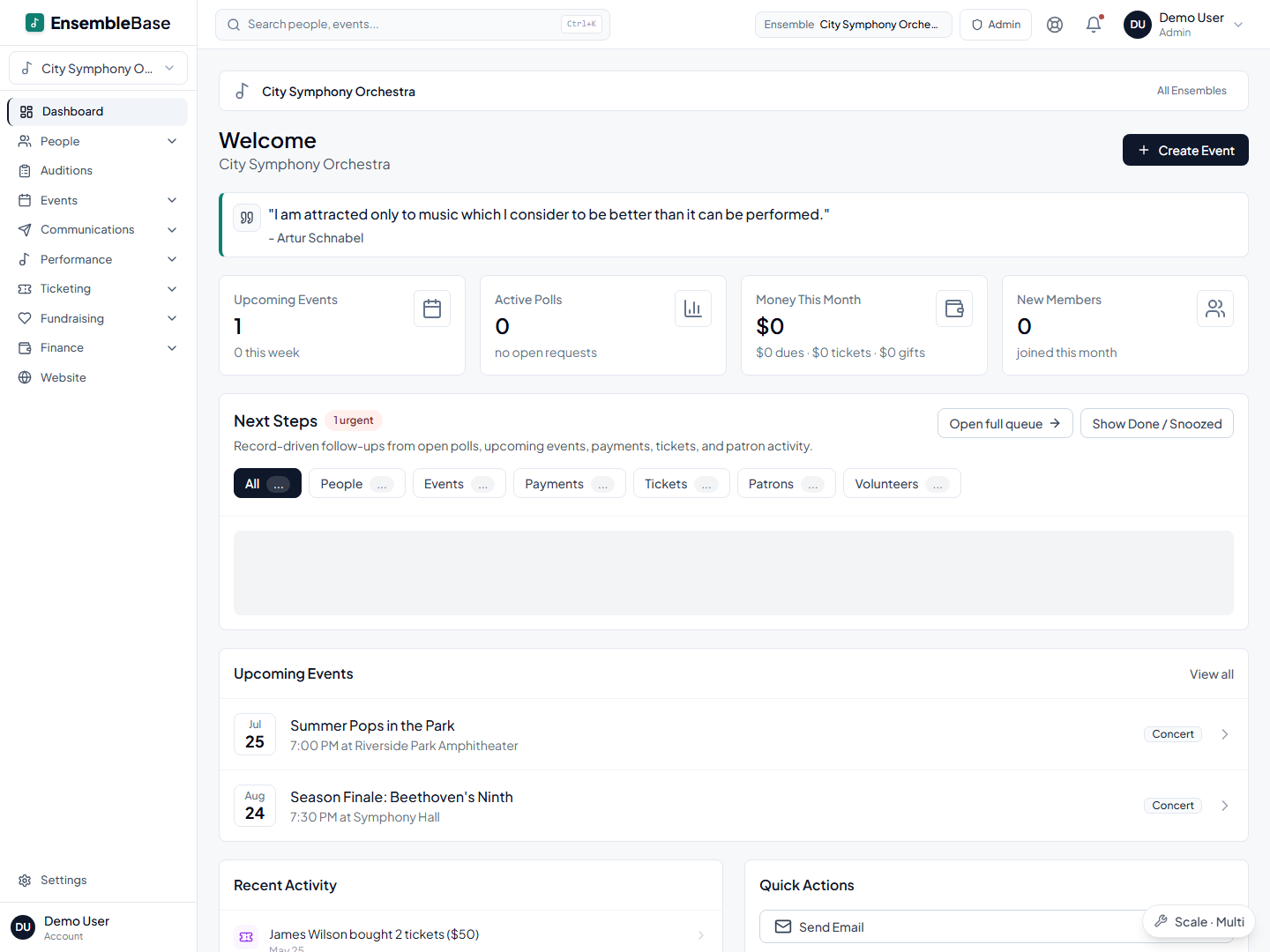
One roster powers everything
In Arts in One, your member list is entered once and reused everywhere. Every tool below works from the same roster — no re-typing names, no out-of-sync copies.
Frequently asked questions
How much should a community ensemble charge in dues?
Calculate the portion of your budget that dues must fund, then divide it by the expected number of paying members. For example, a $5,000 gap across 50 paying members gives $100 per season. Allow for waivers and payment timing, and explain the costs the amount covers.
What do we do about members who genuinely can’t afford dues?
Publish a confidential hardship path: one named officer, usually the treasurer or president, who can reduce or waive dues quietly. It should never be a form the whole board reviews or a meeting agenda item. Book waived amounts to a scholarship line in aggregate so the budget reconciles without naming anyone.
How many payment reminders should we send?
A possible starting schedule is the season-opening announcement, a reminder at the due date, and a neutral follow-up about two weeks after. Send them automatically and only to members with an open balance. An automated reminder from the system carries far less social weight than a personal note from the treasurer, which is exactly the point.
Should we publish a list of who has and hasn’t paid?
No. Public paid/unpaid lists, names read at rehearsal, and spreadsheets circulated to the board all shame members and damage trust — people leave ensembles over it. The working pattern is private visibility: each member sees their own balance in the member portal, and only authorized administrators see the full picture of open balances.
Keep reading
Money & fundraising
Paying musicians: engagement terms and payment records
Read the guideOperations
Planning a concert season: the master timeline and checklist
Read the guideOrchestra operations
Community orchestra management software that replaces the spreadsheet stack
Read the guideTicketing & box office
How to sell tickets for a community concert
Read the guideThe bottom line
Let the system do the asking.
Arts in One ties dues to your roster, lets members see and pay their balance in the member portal, records the checks that still arrive at rehearsal, and sends reminders on a schedule you set once. The treasurer gets a dashboard instead of a season of awkward conversations.
Request a demo