Running ticketing involves more than publishing a buy button. Your team needs an accurate event page, a capacity plan, a way to handle sales at the door, and records it can reconcile afterward. Arts in One connects those tasks with the event on your calendar.
Your event page already exists
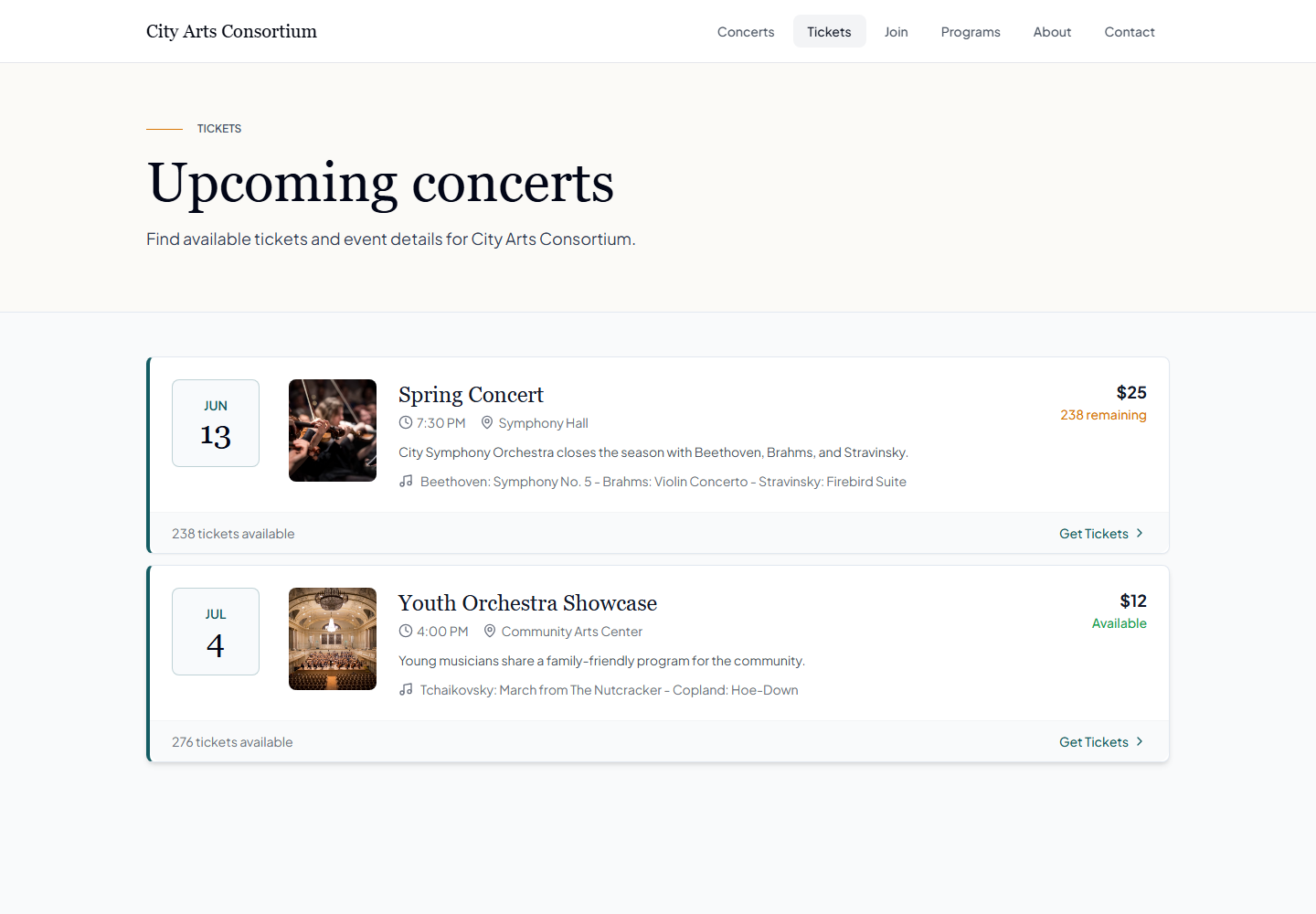
In Arts in One, ticketing starts from the events you already scheduled. The concert on your calendar, with its date, time, venue, and program, becomes a public event page where anyone can buy tickets. When the date or venue changes, the public page follows. There is no second copy of the concert to keep in sync.
Reserved seating, general admission, or both
If your hall has assigned seats, you can sell from a seat map on the Scale plan: buyers pick their seats, and you can hold blocks for patrons, comps, or the choir's families. Worth checking before you plan a season around it, because it is the biggest tier step in the product: seat maps are the one ticketing feature that needs Scale rather than Pro. If your venue is folding chairs in a church nave, general admission works on both tiers with a simple capacity, and remaining capacity shows on the dashboard either way.
Confirm costs before setting ticket prices
Review the current plans and confirm applicable service fees, processing charges, and fee-coverage options for your organization. Compare the checkout total and estimated proceeds using your own ticket prices and order sizes. Processing estimates can differ from final charges. The fee comparison guide explains how to build a consistent comparison.
How the money moves
Where does ticket money land? In your organization's own Stripe account. Review your connected account terms for fees, balances, and payout availability.
When? Sales land in your Stripe balance as they happen, before the concert, and Stripe pays out to your bank on its standard rolling schedule. You can watch the balance and recent payouts inside Arts in One. New Stripe accounts have onboarding and a slower first payout, so connect your account well before sales open.
What happens on a refund? You record the refund in Arts in One, which releases the seats and invalidates the tickets, and complete the payment in your Stripe dashboard. Check the applicable terms for which fees are returned.
Disputes are handled through your connected Stripe account. Review the applicable dispute received and response fees in Stripe’s current terms. Keep order and check-in records to support any response; the provider and card network determine the outcome.
Concert night, worst case
Every ticketing page describes the happy path. Here is the other kind of night, and what actually happens:
The lobby wifi dies at 6:40. Check-ins need a connection, so the insurance is paper, and it costs one click: export and print the attendee list every concert afternoon, whether you expect trouble or not. If the network drops, check people off the printed list and mark them checked in from the attendee search once it returns. Nobody waits in the cold while a volunteer reboots a router.
Someone shows a screenshot of a ticket you already checked in. Each ticket can be checked in once; the second attempt shows it has already been used. Your door lead makes the human call, with the facts on the screen instead of two people's word against each other.
If a concert is cancelled or rescheduled, communicate the options to buyers and apply your published refund policy. Confirm which fees are returned under your platform and processor terms, and reconcile refunds in both systems.
The buyer list is your next audience
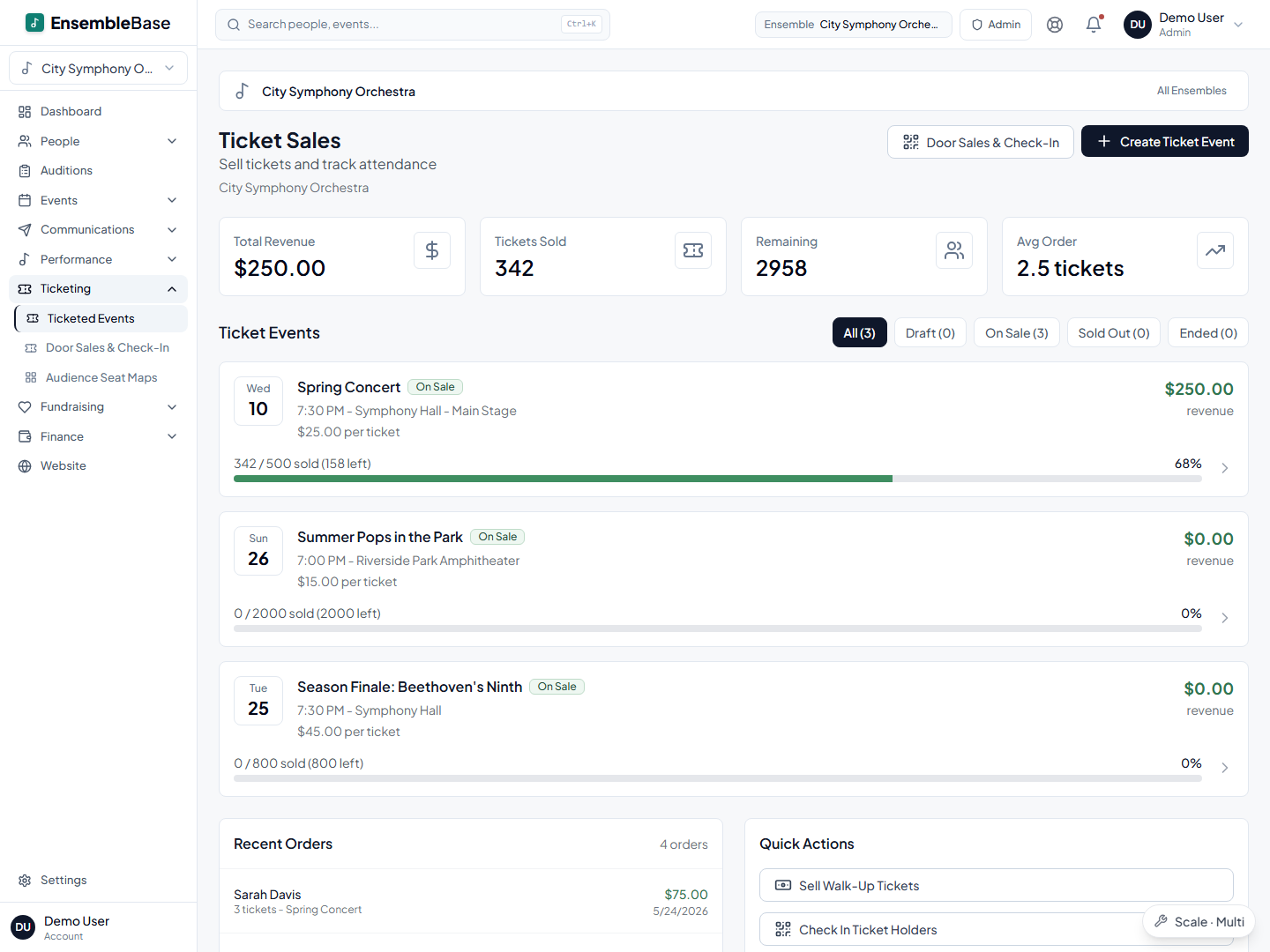
Online buyers are added to your People records automatically, matched by email to anyone already there. The family that bought four tickets in December is visible when you plan the spring donation ask, next to your members and donors, and the thank-you email after the concert goes out through the same system that sold the tickets. Walk-up door sales are recorded with the order itself, so attendance and revenue stay complete even when the buyer stays anonymous.
One roster powers everything
In Arts in One, your member list is entered once and reused everywhere. Every tool below works from the same roster — no re-typing names, no out-of-sync copies.
Frequently asked questions
What does ticketing cost the ensemble?
Review the current plans and confirm applicable ticketing and processing charges for your organization. Include any subscription and required seating features in your comparison, along with transaction costs. Do not assume a fee-coverage option guarantees exact net proceeds.
How do refunds work?
You record the refund in Arts in One, which frees the seats and invalidates the tickets, and complete the money movement in your own Stripe dashboard. Refunds issued in Stripe sync back automatically. Check the applicable terms for which fees are returned.
Can we sell tickets at the door?
Yes — by card through Stripe, or recorded as cash, check, or comp. Door sales land in the same records as advance sales, so walk-ups count toward the same revenue and attendance totals, and volunteers can check in advance buyers from the same screen.
Do buyers need an account to purchase tickets?
No. The public event page works like a normal checkout: buyers pick seats or quantities, pay by card, and receive their tickets by email. Online buyers are added to your People records automatically, matched by email.
Keep reading
Ticketing & box office
Ticketing fees compared: how to calculate your concert costs
Read the guideTicketing & box office
How to sell tickets for a community concert
Read the guideSeating & staging
Seating chart software that starts with your roster, not a blank canvas
Read the guideOrchestra operations
Community orchestra management software that replaces the spreadsheet stack
Read the guideStart here
Your next concert is already half a ticket page.
Put the season on the Arts in One calendar and every concert can have a public ticket page, a seat map, door sales, and a buyer list that feeds your donor pipeline — with the money in your organization's own Stripe account from the first sale.
Request a demo