Community band management software earns its keep when it kills the six-spreadsheet system. Arts in One keeps one roster and generates the rest from it.
Every band that has been around more than a few seasons accumulates this system by accident. A trombonist who moved away in March is still on the email list in June, marked active on the roster, and absent from the dues sheet entirely — because those are three different files maintained by three different volunteers.
Where the six-spreadsheet system breaks
The roster spreadsheet, edited by the secretary, current as of last spring.
The sub list: a doc of phone numbers, half of them stale.
The attendance tracker, filled in by whichever section leader remembered.
The dues sheet: the treasurer’s file, reconciled against memory.
The ticket tally: a login one person has, on a platform that takes a cut.
The email list, copied from the roster in September and never again.
Any one of those errors is survivable. What wears people down is that every question — who is playing Saturday, who owes dues, how many tickets have sold — starts with working out which file to open and which volunteer to ask.
Summer season: parades, festivals, and who can actually make it
Concert bands have a scheduling problem orchestras mostly don't: the summer run of parades, park concerts, and festival gigs, each with its own call time and its own subset of the band. Availability polling in Arts in One works per event. Post the whole summer schedule, let members respond date by date, and see for each gig who's in, who's out, and who hasn't answered. When the Memorial Day parade shows three trumpets, you know two weeks out, while there's still time to call a sub from the roster.
Scheduling, reminders, and follow-ups run off the same data. The reminder email for the festival gig goes to the people playing it, and the nudge about the availability poll goes only to the people who haven't responded.
One roster that shows your instrumentation balance
In Arts in One, the roster is organized by section, with chairs, principal status, and substitute status on each member. Your instrumentation balance is visible the moment you open it: eighteen flutes and two tubas is a familiar community band problem, and when each section's headcount is on screen, recruiting stops being a vague "we need more low brass" and becomes a specific target.
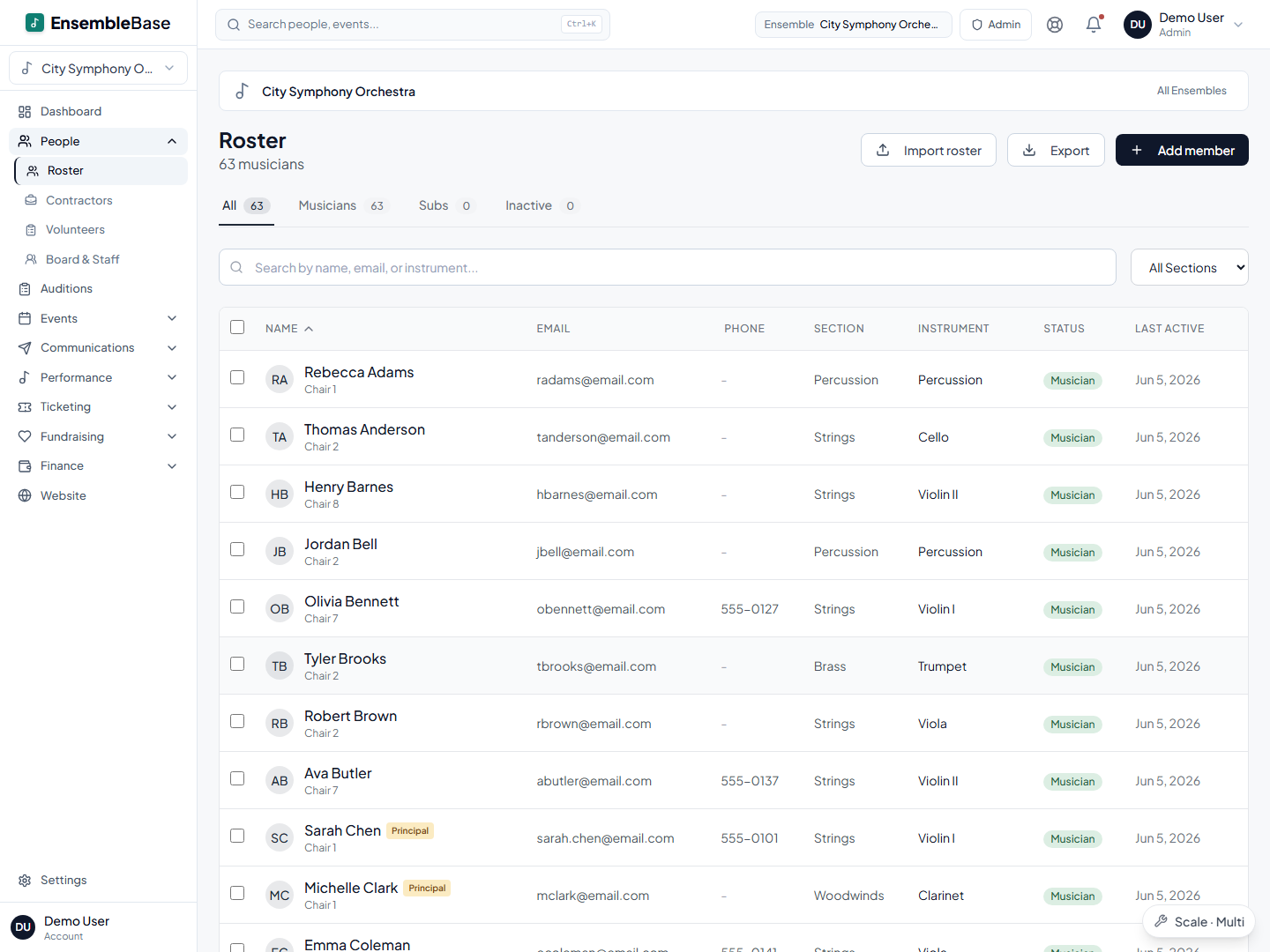
A gig-based player who covers the July 4th concert but skips the fall season is one roster record with a sub status, instead of a name added to and removed from five files.
Seating charts filled from the roster
The seating chart builder hands you a starting template to reshape into band rows, with your roster beside it: filter by section or by who's unplaced, and drag players onto seats. When a clarinetist switches chairs, that's a drag and a swap prompt, not a redrawn chart. Publish, and the chart is on every player's portal page.
Dues and tickets in the same place as everything else
Dues tracking sits on the member record. Ticketing connects public event pages, online and door sales, and check-in with the event. Review current plans for feature availability and confirm applicable service and processing charges before setting ticket prices.
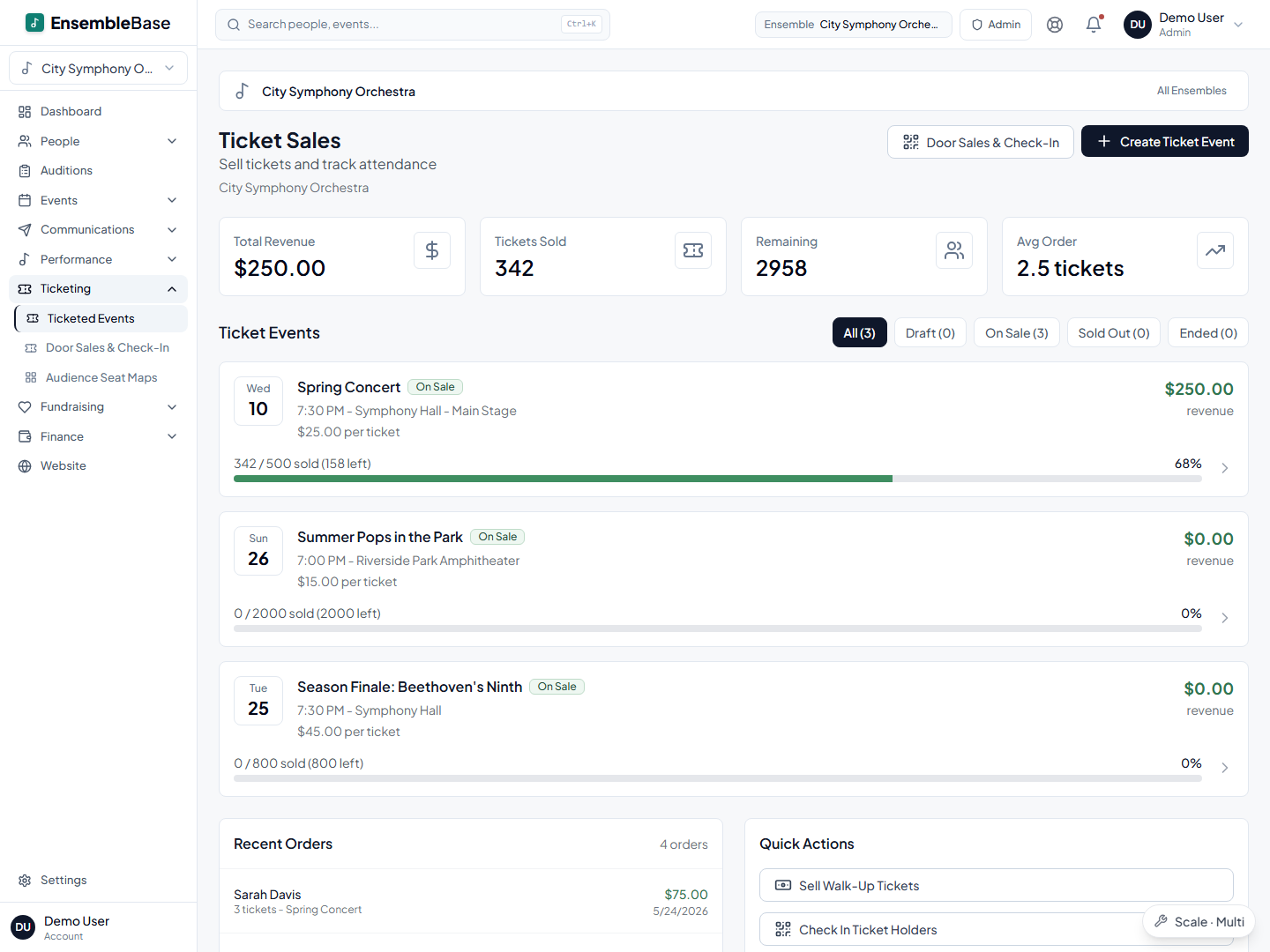
One roster powers everything
In Arts in One, your member list is entered once and reused everywhere. Every tool below works from the same roster — no re-typing names, no out-of-sync copies.
One gig, start to finish
For an illustrative workflow, take a September festival slot. You post the date, and the availability poll goes out to the current roster. The results show you're short a bass clarinet, so you message the one sub with bass clarinet on her record. The seating chart takes four drags from the roster panel, the reminder email goes only to the people playing the gig, and by the time the trailer is unloaded that night, door sales have already landed in the same dashboard as everything else. The six spreadsheets never came out.
Who owns the account when the treasurer retires?
Every long-running band has a version of this story: the ticketing login belonged to Debbie, Debbie retired to Arizona, and now the spring concert's sales report lives behind a password reset sent to an email nobody checks. Personal accounts on outside platforms leave with the person who created them.
Arts in One is the band's workspace, with multiple administrators and four access levels (owner, admin, manager, member). A handover is an invitation and a revocation: the new treasurer gets admin access, the old access is turned off, and every record stays exactly where it was. CSV exports are available for records such as the roster and ticket buyers. Check the export scope for the records you need before migrating. Getting in is covered the same way: if your records are scattered across those six spreadsheets today, the Arts in One team will migrate them for you.
Frequently asked questions
Do our members need to download an app?
No. The member portal is a plain web link: schedule, availability polls, music, seat assignment, and dues status in any browser. Members who ignore the portal entirely still get every email and reminder, and can answer availability polls straight from the email link.
Can it handle our mixed instrumentation and doublers?
Yes. The roster supports concert band sections with chairs and substitute status, and a player who covers more than one instrument is one record, not two entries in two spreadsheets.
Can we sell tickets to our concerts through it?
Ticketing supports online and door sales. Check the current plans for feature availability and confirm applicable charges before setting your prices.
Does Arts in One work for bands, or mainly orchestras?
Both, equally. Concert bands, orchestras, choirs, and chamber groups all use the same roster, seating, availability, dues, and ticketing tools. The row-based stage builder shapes band setups as readily as orchestra fans, and the section model fits any instrumentation.
What does Arts in One cost?
For most community bands the practical answer is the Pro tier, because that is where seating charts and ticketing start; the Core tier below it covers roster, availability, and dues for a single ensemble. Current figures are on the plans page.
Keep reading
Seating & staging
Seating chart software that starts with your roster, not a blank canvas
Read the guideTicketing & box office
Concert ticketing software connected to your season
Read the guideTicketing & box office
Ticketing fees compared: how to calculate your concert costs
Read the guideOperations
Planning a concert season: the master timeline and checklist
Read the guideThe bottom line
Retire the six spreadsheets.
Arts in One keeps one roster and generates the rest (seating charts, availability, schedules, dues, ticketing, and the member portal) so your band's answers live in one place instead of six files that disagree.
Request a demo